15 October 2013

Conepine, oops, Pinecone

 © 7evenPoint @ deviantart

 © c13h18o2 @ deviantart

 © ChaosHumor @ deviantart

 © criesblood @ deviantart

 © deadlifelesscorpse @ deviantart

 © JimmyToTheBe @ deviantart

 © mpdti @ deviantart

 © MSofiaTeixeira @ deviantart

 © Oseike @ deviantart

 © Outcastsgabby @ deviantart

 © runchbiteNuva @ deviantart

 © settlednomadic @ deviantart

 © Ting-Yu @ So lazy

 © xmindizzle @ deviantart

 © Xx-Moiraine-Sedai-xX @ deviantart

© ZsofiaGyuker @ deviantart


14 October 2013

Nocturne

 © Angi Wallace (2013)


 © Avi Abrams (2007)


 © Captain Tenneal (2013)


© Denis Richard (2013)


© Roy Niswanger (2009)


© Serguei Koultchitskii (2010)


The red-eyed tree frog (Agalychnis callidryas) is an amphibian native to rainforests in Central America.

During the day, red-eyed tree frogs mostly sleep, keeping their eyes closed to help camouflage themselves. If disturbed, a frog will abruptly reveal his red eyes, startling potential predators. This often gives the frog just enough time to jump away to safety. Red-eyed tree frogs have very strong suction cup toe pads that make them agile climbers. Adult males are only about 5 cm (2 inches) in length while the females tend to be larger at 7.5 cm (3 inches). Males croak and quiver, like a song and a dance, to attract females. These frogs change color according to their mood, from dark green to a reddish-brown.

11 October 2013

Rare birds of China

Black-necked Crane, Grus nigricollis

J. Fenwick Lansdowne, often described as the successor to John James Audubon, was born in 1937 to British parents in Hong Kong. He died in Victoria BC Canada – where he had lived for many years – just before his 70th birthday in the summer of 2008. He was taught to paint by his mother, herself an accomplished artist trained in traditional Chinese watercolor techniques.

Rare Birds of China is his most recent project, one which required almost 10 years to complete. It was commissioned in 1984 as a unique record of China's rare and endangered birds. From its inception, it has been a truly international project. The 32 birds in the series were selected with the help of leading Chinese ornithologists, professors Cheng Tso-Hsin and Hsu Weishu. This list was compiled with a particular concern for those species increasingly threatened by environmental hazards and loss of habitat.

J. Fenwick Lansdowne traveled extensively in China, visiting museums and observing birds in zoos and in their natural habitats. Museums in China, England and North America provided advice and assistance with the loan of bird skins for the artist's reference. British mountaineer Chris Bonington took detailed photographs of the habitats of Himalayan species for the artist's use.


 Blyth's Tragopan, Tragopan blythii


 Himalayan Snowcock, Tetraogallus himalayensis


 Impeyan Monal, lophophorus impejanus


 Japanese Crane, Grus japonensis


 Mikado Pheasant, Syrmaticus mikado


 Rufous-necked Hornbill, Aceros nipalensis


 Satyr Tragopan, Tragopan satyra


 Sclater's Monal, Lophophorus sclateri


 Siberian Crane, Grus leucogeranus


 Silver Oriole, Oriolus mellianus


 Temmincks Tragopan, Tragopan temminckii


White Stork, Iconia ciconia


So so beautiful.
(Full series here.)


08 October 2013

The Trans-Siberian railway in reverse

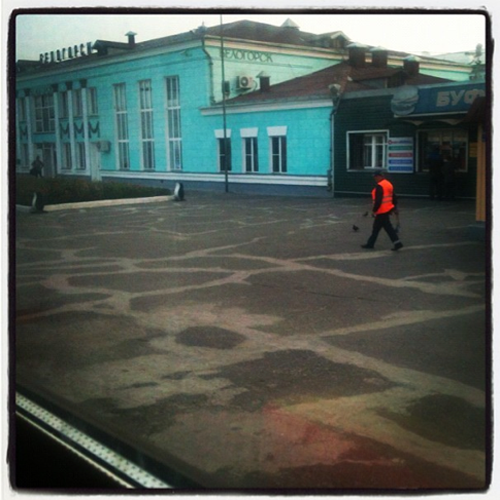
From east to west, from Vladivostok to St Petersburg, with flickr and instagram, a Trans-Siberian voyage backwards.

Vladivostok 9909 km

Ussuriysk 9797 km
Ruzhino 9552 km 
Guberovo 9459 km
Vyazemskaya 9271 km

Khabarovsk 9143 km

Birobidzhan 8970 km


Belogorsk 8485 km

Skovorodino 7925 km
Mogocha 7526 km
Zabaikalsk 7205 km
Karymskaya 6912 km


Chita 6816 km

Mogzon 6672 km

Ulan-Ude 6259 km

Baikalsk 6010 km
Slyudyanka 5929 km

Irkutsk 5803 km

Angarsk 5763 km

Zima 5552 km

Nizhneudinsk 5133 km
Ilanskaya 4994 km

Krasnoyarsk 4715 km

Achinsk 4531 km
Bogotol 4463 km
Mariinsk 4330 km
Taiga 4182 km

Novosibirsk 3953 km

Barabinsk 3650 km

Omsk 3326 km

Nazyvaemskaya 3170 km
Ishim 3043 km

Tyumen 2754 km

Ekaterinburg 2428 km

Perm 2047 km
Belezino 1804 km
Glazov 1775 km
Kirov 1567 km
Kotelnich 1480 km

Nizhny Novgorod 1111 km

Vladimir 859 km

Moscow 650 km

St Petersburg 0 km


•