15 April 2012

Tiny miracles


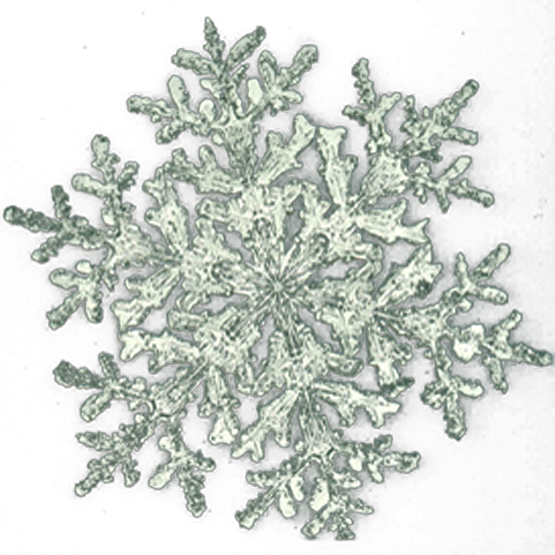
From the earliest memories of our childhood, many of us can remember hearing the phrase No two snowflakes are alike. This discovery was made in Jericho (Vermont, USA) by The Snowflake Man, Wilson Bentley (1865-1931). 


Wilson Bentley was a farmer who made snowflake photography his life-long passion, capturing some 5000 images on old-style photographic plates. He created the first substantial collection of snow crystal photographs.

Snow crystals were difficult to see because they melted so rapidly. Bentley lived in the snow belt region in the USA where the annual snowfall is about 120 inches. So he had many opportunities to study snowflakes. 

When he was a small boy, he was seduced by the natural world around him. He loved to study butterflies, leaves and spider webs. He kept a record of the weather conditions every day. He was fascinated by raindrops. As a young boy, Bentley made more than 300 drawings of snow crystals. At age 15, he began drawing snowflakes while looking at them through a microscope that could magnify the tiny snowflake from 64 to 3,600 times its actual size.

By adapting a microscope to a bellows camera (and years of trial and error) he became the first person to photograph a single snow crystal in 1885. 

To obtain his pictures, he had to create a complex system that required working rapidly to achieve a photograph before the snowflakes melted. Note that snow crystals are clear, not white. Bentley illuminated his crystals from behind (giving a bright background) and then he made the background dark.

He learned that the reason no two snowflakes are exactly alike is because all ice crystals (shaped like simple plates, bullets, needles, solid or hollow columns, dendrites, sheaths) are hexagonal. As they descend from the clouds, they ride air currents up and down for an hour or more through regions of differing temperatures and humidity that leave their marks on snowflakes’ growth and shape. Bentley was fascinated by the fact that the crystal design variations were endless.


The farmer-scientist-artist poetically described snowflakes as tiny miracles of beauty and snow crystals as ice flowers.

The Snowflake Man died of pneumonia on Christmas Eve in 1931, shortly after hiking through a snowstorm. Wilson Bentley literally died with his boots on.


Today! icy photography looks a little bit different… Please go discovering beautiful modern snowflakes in ChaoticMind75's folder called Snowflakes and snow crystals on flickr.


   __/  \__
   _\/\/_
   \_\_\/_/_/
   / /_/\_\ \
   __/\/\__
    \  /


07 April 2012

Luxurious identity

Mostly undressed and masked. Old masters oil painting techniques. Many layers of oil. Divans brocaded in satin. Provocative and elegant. Victorian-style naturalism. Voluptuous. Pearl jewelry. Fantasy. Dreamy. Eyes looking at the viewer's eyes. Lavish. Mysterious. Flowers in the night. Lush. Toys. Breasts. Cats. Fancy costumes. Attractive beds. Folds of drapery. Issue of gender identity.

Old photographs. Victorian portraiture. Enigmatic mises en scène. Wicked sense of humor. Extravagant. Allegory. Rococo. Silken lingerie. Resplendent colors. Warm colors. Kitsch. Generous fancy ornamentation. Incongruous accessories. Seductive interiors. Skin. Imagination. Copious furniture. Luxuriant. Nudes. Exquisitely detailed backgrounds. Flamboyant. Immaterial landscapes. Heavenly invitation.

Colette Calascione does some beautiful oil paintings in techniques that are found in old masters artworks.

 Denial

 Dream of the Hungry Ghost

 He Is Who

 Illumination

 Self Portrait with Internal Landscape

 Cat Mask

 Leda and the Swan

 Milky Way

 Observation Day

 Bee Boy

 Bliss Ninny

 Phoenix Moon

 Swimmer

 Chick Fight

 The Love Letter

Wild Rose


Colette Calascione was born in San Francisco, USA. She resides in New York.

Find her on facebook.

Her work is at Nancy Hoffman Gallery.


Propellerheads and Shirley Bassey - History Repeating


25 March 2012

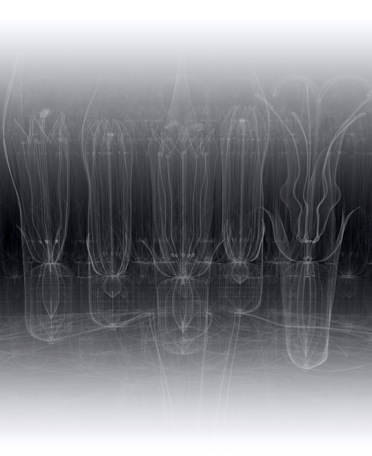
Flora Digitala

Commelina communis L. - front - b


Macoto Murayama cultivates inorganic flora. First, he chooses the plant and finds the real flower. Second, he dissects the flower cutting the petal and ovary with scalpel and observes it with magnifying glass. Third, he makes sketches and photographs the parts of dissected flower. Forth, he models its form and structure using 3D software. Fifth, he renders separate parts and creates a composition using Photoshop. Sixth, he imposes admeasurements, parts names, scale, scientific name, etc.

Here it is, The Flower of Totalitarian Scientific Conscious: properly fixed, totally measured, strictly nominated and distinctly shown. It is not only an image of a plant, but representation of the intellect’s power and its elaborate tools for scrutinizing nature. The transparency of this work refers not only to the lucid petals of a flower, but to the ambitious, romantic and utopian struggle of science to see and present the world as transparent (completely seen, entirely grasped) object. Paradoxically, this scientific challenge to measure the Universe might eventually become one of the sources where art of Murayama draws its strength of fantasy and odor of romanticism, becoming a part of Botech Art, symbiosis of Botanical Art and Technology. (Read more.)


Commelina communis L. - front - ow 

Chrysanthemum-vi-w

Commelina communis L. - side view - ow (detail)

Commelina communis L. - side view - ow (detail)

Japanese lily-v-w

Lathyrus odoratus - top view- (detail)

Lathyrus odoratus -front view-

Lathyrus odoratus -side view- (detail)

Lathyrus odoratus L. -ecology view- (detail)

Rose-i-w

Satsuki azalea-iii-w

Spider lily-i-w

Transvaal daisy-v-w

Yoshino cherry-i-w

Sunflower-vi-b

Sunflower-vi-w


Macoto Murayama is an artist and a member of The Japanese Association of Botanical Illustration.

Yesterday afternoon, this tumblr post from moshita let me know Macoto Murayama.

moshita on tumblr is a strange artistic-anatomic place. Don't go there alone.


Hope you enjoyed this beautiful digital drawing work. Have a great floral day.