08 November 2014

Alley shadows

Alley Shadows

"I'm motivated by the beauty surrounding us in simple, everyday objects and scenes. I paint exclusively in oils and enjoy the challenge of working alla prima, both in the studio and outdoors, usually finishing a piece in a single session."

Michael Chamberlain

Alla prima (Italian, meaning at first attempt) or wet-on-wet is a painting technique used mostly in oil painting, in which layers of wet paint are applied to previous layers of wet paint.


Cafe at Dusk

Enjoy the selection I've made among the huge production of the generously prolific Mr. Chamberlain: 30 beautiful San Francisco square cityscape paintings.


 Cafe on Polk

 California Street

 Corner Store

 Crossing Grant

 Electric Bus

 Ferry Building

 Golden Hour

 Harrison at Embarcadero

 Hyde and Lombard

 Jackson Street

 Jones at Glover

 Larkin and Broadway

 Last Light, Side Street

 Looking North on Polk

 Mission Alley

 Narrow Street, Telegraph Hill

 North Tower

 Powell Street

 Red Truck Turning Left

 Sandwich Shop

 Sunset Power Lines

 Taillights

 Tall Buildings on Leavenworth

 Tree Lined Street

 View from an Alley

 View of Alcatraz from Hyde

 Washington and Mason

West on Broadway


06 November 2014

Striving for perfection

Albatross

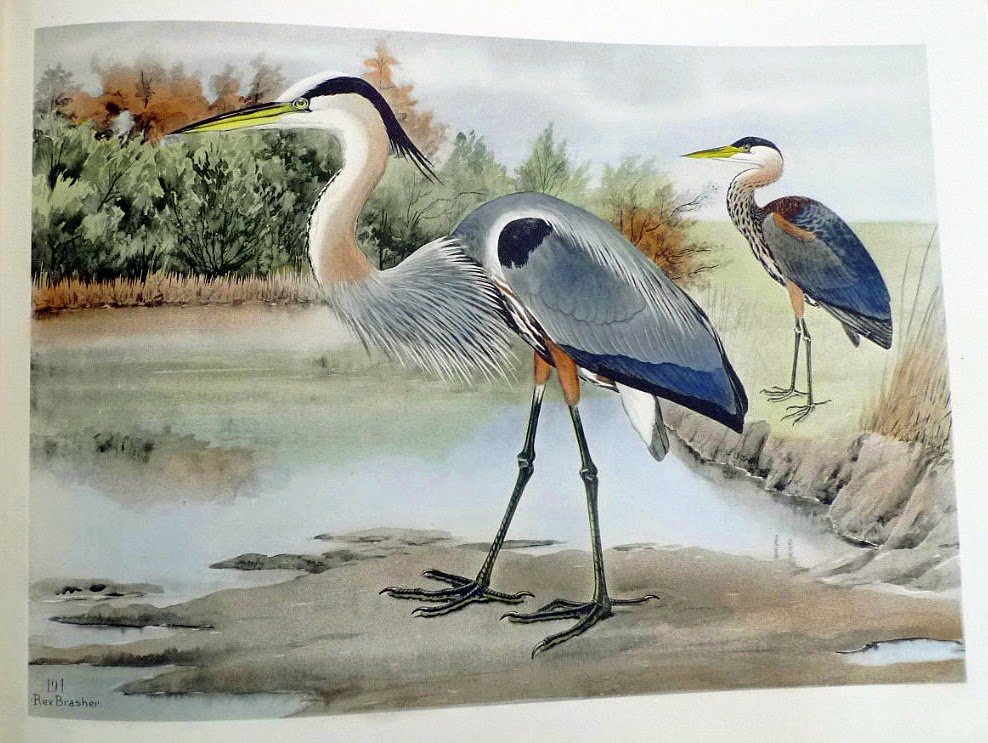
A wonderful (and unexpected – of course) surprise yesterday afternoon: the bird painter Rex Brasher.
 

Bald eagle

Known as "Connecticut's 20th-century Audubon", Rex Brasher (1869-1960) was born in Brooklyn, USA. As a youngster he became fascinated with birds. In 1878, at the age of 8, Brasher determined to paint all the birds of North America from life–and better [ahem] than John James Audubon (1785-1851).

 
Belted kingfisher

Rex Brasher started painting birds seriously around age 16 and produced 875 watercolors depicting 1,200 species and sub-species of North American birds. 
 
 
Caracara

He strove for perfection, attempting to make his paintings as lifelike as possible by portraying birds in their natural habitats, illustrating gender differences and recording their everyday activities. 
 

Cinnamon teal

Visiting every state, Rex Brasher captured birds that are now extinct, including the Heath hen, Passenger pigeon and Eskimo curlew. 


Eagle and ducks

He often financed these trips by working at odd jobs, including stints on fishing boats (this allowed him to work while also studying seabirds). He also funded his work through more unusual means, such as betting on the horses. 
 

Great blue heron

Often unsatisfied with his results, he twice destroyed all his paintings, an estimated 700 canvases.
 
 
Mangrove cuckoo

In 1911, after having received a $700 commission for illustrating a book, Rex Brasher purchased a farm in Connecticut, calling it Chickadee Valley. 
 

Osprey
 
By 1924 he had completed his series of paintings and attempted to have his work published. But the cost of printing all the plates in color was prohibitive. 
 

Roseate tern

Rex Brasher came up with a less costly solution: he hired a gravure company to produce black-and-white reproductions. And then he hand-colored the prints himself, using an airbrush and stencil technique that he’d developed. 
 

Snowy egret

This labor intensive process took four years to complete. The final book, Birds & Trees of North America, was produced in a limited edition of 100 sets of 12 volumes and included almost 90,000 hand-colored reproductions.


Swallow-tailed kite

•••
 
I had a hard time finding large images without watermarks…


29 October 2014

Les peintures de gardiennes d'oies

Jean-François Millet, Julien Dupré, Alfred Sisley, Camille Pissarro (et d'autres) en ont peint plus d'une – un thème qui a l'air récurrent chez quelques impressionnistes et chez les naturalistes. Il m'a semblé judicieux d'exclure les représentations illustrant La petite gardeuse d'oies (Die Gänsemagd), le conte couché sur papier par les frères Grimm en 1815. J'ai fait un tri parmi la soixantaine de tableaux trouvés en deux après-midis de recherche. Et voici les magnifiques peintures de gardiennes d'oies que je vous présente aujourd'hui.


Rafael Angelot

Agnes L. Atkinson

Teodor Axentowicz (1859-1938) 

Émile Barau (1851-1930) 

Nikolai Kornilievich Bodarevsky (1850-1921)

William-Adolphe Bouguereau (1825-1905) La gardienne d'oies (1891)

Julien Dupré (1851–1910) 
 
Thérèse Marthe Françoise Dupré (1877-1920)

David Hyde

Eugène Labitte (1858-1937) 

John Lavery (1856-1941) Goose Girls (1885)

Jan Mankes (1889-1920) Ganzenliesje (1911)

Jean-François Millet (1814-1875) La gardienne d'oies (1863)

Philip Richard Morris (1836-1902)

Camille Pissarro (1830-1903) La fille aux oies à Montfoucault, Gelée blanche (1875)

Valentine Cameron Prinsep (1838-1904)

Alfred Sisley (1839-1899) La gardeuse d'oies (vers 1885)

Johannes Strieder


Cette drôle d'introduction convie-t-elle à la lecture du conte? À vous de voir:

"Le conte de la Gardeuse d'oies invite à habiter le monde qui nous entoure de notre présence éveillée en la projetant dans les objets. Cela permet d'obtenir leur concours dans les situations critiques. Il faut pour cela apprendre à traduire ses inspirations en des formules vibrantes." Euh…


Paul Hey (1867-1952) The Goose Girl Fairytale Illustration


22 October 2014

Operatic complex aria

The Pacific wren is a tiny, dark brown bird with a very short tail, narrow pale eyebrow and heavily banded flanks and belly.

Quiet here © Dan

In full song this time © Roger

The Pacific wren's song is a high-pitched, varied and rapid series of musical trills and chatters. When recorded and played back at a lower speed, it reveals a remarkable blend of halftones and overtones all sung at the same time.

Visit Audubon magazine: Pacific wren's song slowed down and listen carefully and enjoy the lilliputian bird's melodic elaborate ballad.