10 September 2012

Honeycomb

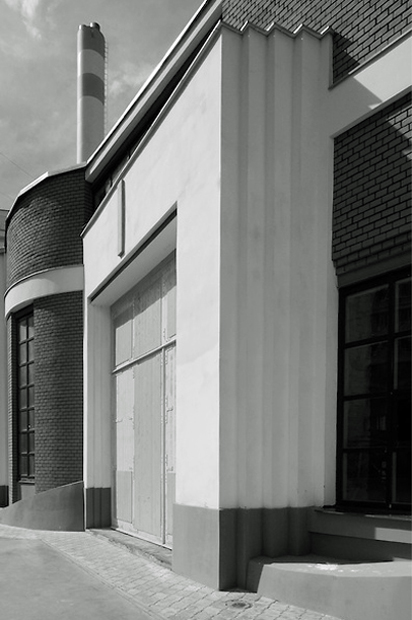
© Igor Palmin

The finest existing specimen of Konstantin Melnikov's work is his own Krivoarbatsky Lane residence in Moscow, completed in 1927-1929.

The highly original design consists of two interlocking upright cylinders with numerous elongated hexagonal windows and a large front wall of glass. The house was built with traditional Russian materials (stuccoed brick for exterior walls and wood for floors) used structurally in inventive ways.

The recognized masterpiece of architecture is a honeycomb lattice shell made of bricks with hexahedral cells.

The similar lattice shells out of metal were patented and built by the great Russian engineer and scientist Vladimir Shukhov (1853-1939).

Double curvature steel lattice shell by Shukhov in Vyksa, 1897

Konstantin Melnikov's house consists of two intersecting cylindrical towers decorated with a pattern of hexagonal windows.


 © Igor Palmin

 © Igor Palmin

 © Igor Palmin

 © Igor Palmin

 © Igor Palmin

 © Igor Palmin

 © Igor Palmin

 © Igor Palmin

 © Igor Palmin

 © Igor Palmin

 © Igor Palmin


Igor Palmin was born in Volgograd (previous names, Tsaritsyn (1589–1925), Stalingrad (1925–1961)) in 1933. He lives in Moscow. He works mostly in architecture photography since 1980. You may look at his beautiful black and white portfolio here: flickr/igor palmin


Melnikov House (1927-1929) by Konstantin Melnikov


Melnikov's 1929 house during construction


06 September 2012

Chinook international sensation

The Kalakala in 1935, next to the Bainbridge, a typical ferry of the 1930s.

November 1934
Lake Washington Shipyards, Kirkland, WA, USA, construction begins on the world's first streamlined vessel.


Streamlined means designed or arranged to offer the least resistance to fluid flow.


Construction and the shipyard work the Kalakala is supervised by James Murphy and naval architect Helmuth W. Schmitz, who completes the blue print drawings.


William Thorniley names the new ferry Kalakala, which means flying bird in the local Chinook Indian language.


July 3, 1935 12:45 PM
The Kalakala commences her maiden voyage with great fanfare; estimated citizens crowd: 100,000.

Under command of Capt. Wallace Mangan, the Kalakala makes a speed of 17.3 knots and is expected to do better after refinements are made.


July 4, 1935
The Kalakala starts daily service from Seattle to Bremerton. Starting at 6:30 am, she makes six round trips daily. Fares are 45 cents for passengers and $1.10 for autos and driver. Every evening at 8:30 she leaves Seattle for a Moonlight Cruise that lasts until 12:30 am. Cost is $1.00 per couple to dance to Joe Bowen and the Flying Bird Orchestra.


The red velvet chairs in the forward cabin are moved aside to provide a dance floor and music is electrically piped throughout the ship to all decks.


1935
Postcards circulate around the country, showing off Seattle's newest ferryboat. The Kalakala is an international sensation.

The Kalakala in Victoria, BC, Canada as a Washington State Ferry

1951
There were some immediate cosmetic changes to the ferry. She had a green stripe painted around her guards, and her interior was repainted in white and green enamel paint.

Passengers on the upper deck viewing area.

On October 2010 the Art Deco Society of California (ADSC) recognized the unique historic and cultural significance of the Kalakala.

Etc. kalakala dot org / history 


Official number: 226244
Radio call numbers: WA6703
Built in 1934-35
Length: 276.5
Beam: 55.7'
Draft: 16'
Autodeck clearance: 11.2'
Propulsion: direct drive Busch-Sulzer diesel, 3000 HP
Speed: 16 knots
Name translation: Chinook jargon, Flying Bird

September 24th, 2004: the Kalakala is towed to her new home in Tacoma, WA.


01 September 2012

On the front end of the avant-garde

Gosplan garage (c. 1936) photographer unknown; architect: Konstantin Melnikov


Konstantin Stepanovich Melnikov (Константин Степанович Мельников; 1890-1974) was a Russian architect and painter.

His architectural work, compressed into a single decade (1923–1933), placed Melnikov on the front end of 1920s avant-garde architecture.

Although associated with the Constructivists, Melnikov was an independent artist, not bound by the rules of a particular style or artistic group.

In 1930s, he refused to conform with the rising Stalinist architecture. [Stalinist architecture is a term given to architecture of the Soviet Union between 1933 and 1955. Very very huge, with excesses!]


Main building of the Moscow State University: Stalinist architecture


Konstantin Melnikov withdrew from practice and worked as a portrait painter and teacher until the end of his life.


☟

Twelve beautiful black and white photos of Konstantin Melnikov's buildings by Yuri Palmin, a Russian architectural photographer.


Burevestnik factory club


 Burevestnik factory club


Bus garage (Bakhmetievsky)


 Bus garage (Bakhmetievsky)


 Club of the Dorkhimzavod chemical plant


 Club of the Dorkhimzavod chemical plant


 Gosplan (State Planning Committee) garage


 Gosplan (State Planning Committee) garage


 Rusakov club


 Rusakov club


 Truck garage


Truck garage


All photos taken in Moscow © Yuri Palmin


GosPlan Garage (1934-1936) by Konstantin Melnikov


29 August 2012

From the north

The Greek north wind God, strong and violent, is sometimes depicted by a woman, buffeted by the wind.

In ancient Greek religion and myth, the Anemoi were wind gods who were each ascribed a cardinal direction from which their respective winds came.

Notus was the south wind; Zephyrus, the west wind; Eurus, the east wind; Boreas, the north wind.


Boreas, 450 BC


Boreas is depicted as being very strong, with a violent temper to match. He was frequently shown as a winged old man with shaggy hair and beard, holding a conch shell and wearing a billowing cloak.

Boreas and his brother winds were often imagined as horse-shaped gods.


Boreas - oil painting by John William Waterhouse


The north wind god, in this remarkable painting (1902) by John William Waterhouse, is a woman, buffeted by the wind.


Study of Boreas - chalk on paper by John William Waterhouse


Boreas, the North Wind - recreated by Inglis

 I've found this digital reproduction by Inglis here: Robzentaur1′s blog, art, ego, acceptance and society

Here is the full painting with the background slightly altered, but retaining Waterhouse’s impressionist brushwork. The face is re-createded to make it stronger and more sensuous. Waterhouse’s original face is washed out and fragile looking. The oil paint is badly cracked. I reworked the upper areas of the shawl to create more of a feeling of flow and movement.
- Inglis


 ✴


Mt Boreas, in the western Olympus Range, Antartica, was named after the north wind god.

25 August 2012

Romanticizing marine painting

Two British Frigates


James Edward Buttersworth (1817–1894) was an English painter who specialized in maritime art, and is considered among the foremost American ship portraitists of the 19th century. His paintings are particularly known for their meticulous detail, dramatic settings, and grace in movement.

Source: wikipedia


A ship portraitist who meticulously illustrated America’s Golden Age of Sail, Buttersworth captured a realistic view of sea and sky while incorporating the human element into his work. Buttersworth has long been recognized as a premier maritime artist distinguished by his story telling prowess, as well as his meticulous attention to detail with the brush and palette.

Source: brucemuseum


In order to accent the speed and grace of these vessels, Buttersworth would often elongate the hulls and sails to create a feeling of motion portrayed along a low horizon line. With dramatic skies, churning seas and accurate detail, he ennobled and romanticized sailing ships with what have become historically important paintings that are both beautiful and refined.

Source: vallejogallery


 HMS Brunswick Amidst Other Shipping in the Channel

 Man 'O War

 Out to Sea

 Passing Ramsgate Lighthouse

 The American Clipper

 The Yacht Race

 Around the Point

 Castlegarden

 On the High Seas

 The Alice

 Bound for the Sea

 American Racing Yachts off the East End of Long Island

 American Shipping Displays the Flag

 Coastal Craft in Translucent Waters

 [Untitled]

HMS Sloop Active in Coastal Waters