18 December 2012

Multispring

The Iceberg (1891)


Frederic Church (1826 – 1900) was an American landscape painter. He was a central figure in the Hudson River School of American landscape painters.


While committed to the natural sciences, Frederic Edwin Church was "always concerned with including a spiritual dimension in his works".


In addition to capturing the physical and spiritual beauty of native American scenery, Frederic Church travelled extensively the length and breadth of the continent, depicting tropical forests, spectacular waterfalls, volcanoes and icebergs.


West Rock, New Haven (1849)


The Natural Bridge, Virginia (1852)


Cotopaxi (1855)


The Andes of Ecuador (1855)


Mount Katahdin (1856)


Mount Chimborazo, Ecuador (1857)


Niagara Falls (1857)


View of Cotopaxi (1857)


Frederic Edwin Church
The gorgeous landscapes of Frederic Edwin Church and the music of Aaron Copland: Appalachian Spring.


Originally, Aaron Copland did not have a title for the work, referring to it simply as Ballet for Martha. At its final rehearsal (1944), Aaron Copland approached Martha Graham and asked:


– Martha, what have you named the ballet?
– Appalachian Spring.
– That's nice, but does it have anything to do with the ballet?
– No, I just like the title.


Appalachian Spring is a phrase from a Hart Crane poem, The Dance:

 O Appalachian Spring! I gained the ledge;    
Steep, inaccessible smile that eastward bends    
And northward reaches in that violet wedge    
Of Adirondacks! 


Because he composed the music without the benefit of knowing what the title was going to be, Aaron Copland was often amused when people told him he captured the beauty of the Appalachians in his music. Little known is that the word spring denotes a source of water in the Crane poem; however the poem is a journey to meet springtime.


Springtime in the Levant (1879)


14 December 2012

The frozen landscape


I made several long journeys to the upper and lower extremes of our planet to photograph the shorelines, monolithic ice forms and landscapes of Greenland, Icelandic and Antarctica.


Most of these places are arduous to reach, beyond the borders of domestic transportation routes, accessible only by small aircraft or boat. All are endangered to some extent – threatened by tourism, climate change, industry and the hunt for oil.


– David Burdeny 


This new series, Icebergs, begins to explore what are currently the most geopolitical and geographically sensitive shorelines on earth.

Formally different than my previous work, but motivated by similar principals, these images attempt to encapsulate both the otherworldliness and the vital reality of the northern seas and oceans.

Originally conceived of as a black and white monochrome project, the unique and surreal color palate of these extreme latitudes compelled the addition of color.


– David Burdeny


Nothing is more wonderfully beautiful can exist than the arctic night. It is a dreamland, painted in the imagination’s most delicate tints: its color etherealized. One shade melts into the other, so that you cannot tell where one ends and the other meets, and yet they are all there.

– Fridtjof Nansen (1861–1930) Norwegian Arctic explorer


Antarctica starts here


John Cale - Antarctica Starts Here
 

David Burdeny was born in Winnipeg Manitoba Canada in 1968.

At the age of 12, he started to photograph the prairie landscape and make his own black and white prints in a makeshift darkroom that also served as his bedroom closet. 

Primarily self taught, his architecture and design background greatly influences his penchant for simple exacting photographs of sky, horizon and the marks humankind leaves behind.

David Burdeny was influenced stylistically by photographers before him such as Michael Kenna and Hiroshi Sugimoto.


I was drawn to the fragility and grace of the frozen landscape.

– David Burdeny


11 December 2012

Century of the Lights

Paddling bush


The Bird History Drawings by Sue Johnson
charcoal on paper
50 x 38 inches
 
☟


Sue Johnson is an artist born in San Francisco, USA.

Her work is grounded in the genre of the still life and vanitas, and explores the role of artist-naturalists and the history of collections and collectors as she often works collaboratively with museums, libraries and private collections to develop site-specific exhibition projects. 

Since 1995, Sue Johnson has created work under the rubric of The Alternate Encyclopedia, which serves as a conceptual umbrella for a diverse series of projects that focus on the works of literary figures such as Lewis Carroll and Marianne Moore, New World exploration, and the intersection of art, science and popular culture.


The Alternate Encyclopedia encompasses and comments on issues related to the history of natural history documentation, shifting to more contemporary notions of how we humans construct our understandings of the natural world.

Like our contemporary Guinness Book of World Records, many early engravings were disseminated as proof of oddity before Polaroid cameras and video could capture such things.

In this example a mythological creature is presented in the same context as an orange.

Citrus-breathing dragon with illustration of oranges
gouache and watercolor on paper


This print comments on both the power of visual images to endure, but also the shift in the burden of proof to photography in the mid-19th century.

Simply put, The Rabbit Bush, my own variation on the commonly depicted plant and animal hybrids of Medieval times, becomes extinct exactly at the moment the camera is capable of making it possible to not find an example of such a creature.

The date of 1838 in my title refers to the generally agreed upon date for the invention of the camera for wide-use.

–Sue Johnson

 
Rabbit bush (extinct, last spotted 1838)
intaglio print


09 December 2012

Des glaneuses

Jean-François Millet: Des glaneuses, souvent nommé Les glaneuses (1857)


Sur le tableau du peintre français Jean-François Millet (1814-1875) figurent trois femmes, une vieille et deux jeunes, parmi les plus pauvres de la campagne, puisque contraintes de glaner des épis de blé pour manger. Ce tableau illustre la misère de la population rurale en s'inscrivant dans la veine réaliste, sans misérabilisme. 


Les trois femmes exécutent les trois gestes du glanage: se baisser, ramasser, se relever. Le travail de ces femmes est pénible (courbure du dos, maigreur de la récolte) mais leurs vêtements ne sont pas des haillons. Cette pauvreté (et une certaine fracture sociale) est accentuée par l'apparente richesse de la récolte de blé chargée sur les charrettes en arrière-plan par le maître et les gens de ferme.


Jean-François Millet représente dans le ciel une nuée d'oiseaux, prêts eux aussi à picorer les grains oubliés, à l'instar des glaneuses.


Jean-François Millet: Les glaneuses - dessin à la craie noire pour l'été


Cette très négative critique du méga-magnifique tableau de Jean-François Millet est pénible à lire. Quel arrogant mépris d'élitiste!

« Ses trois glaneuses ont des prétentions gigantesques: elles posent comme les trois Parques du paupérisme. Ce sont des épouvantails de haillons plantés dans un champ et, comme les épouvantails, elles n'ont pas de visage: une coiffe de bure leur en tient lieu. M. Millet paraît croire que l'indigence de l'exécution convient aux peintures de la pauvreté: sa laideur est sans accent; sa grossièreté, sans relief. Une teinte de cendre enveloppe les figures et le paysage; le ciel est du même ton que le jupon des glaneuses; il a l'aspect d'une grande loque tendue. Ces pauvresses ne me touchent pas; elles ont trop d'orgueil. […] »
– Paul de Saint-Victor

La suite Des glaneuses sur Wikipedia


Aristide Maillol (1861-1944): Les glaneuses - lithographie


Camille Pissarro (1830-1903): Les glaneuses  (1889) - gouache, fusain, crayon et aquarelle


Charles Commessy (1856-1941): Les glaneuses (1895) - photographie naturaliste


Eugène Burnand: Les glaneuses (1874)


Frederick Morgan: Les glaneuses (1880)
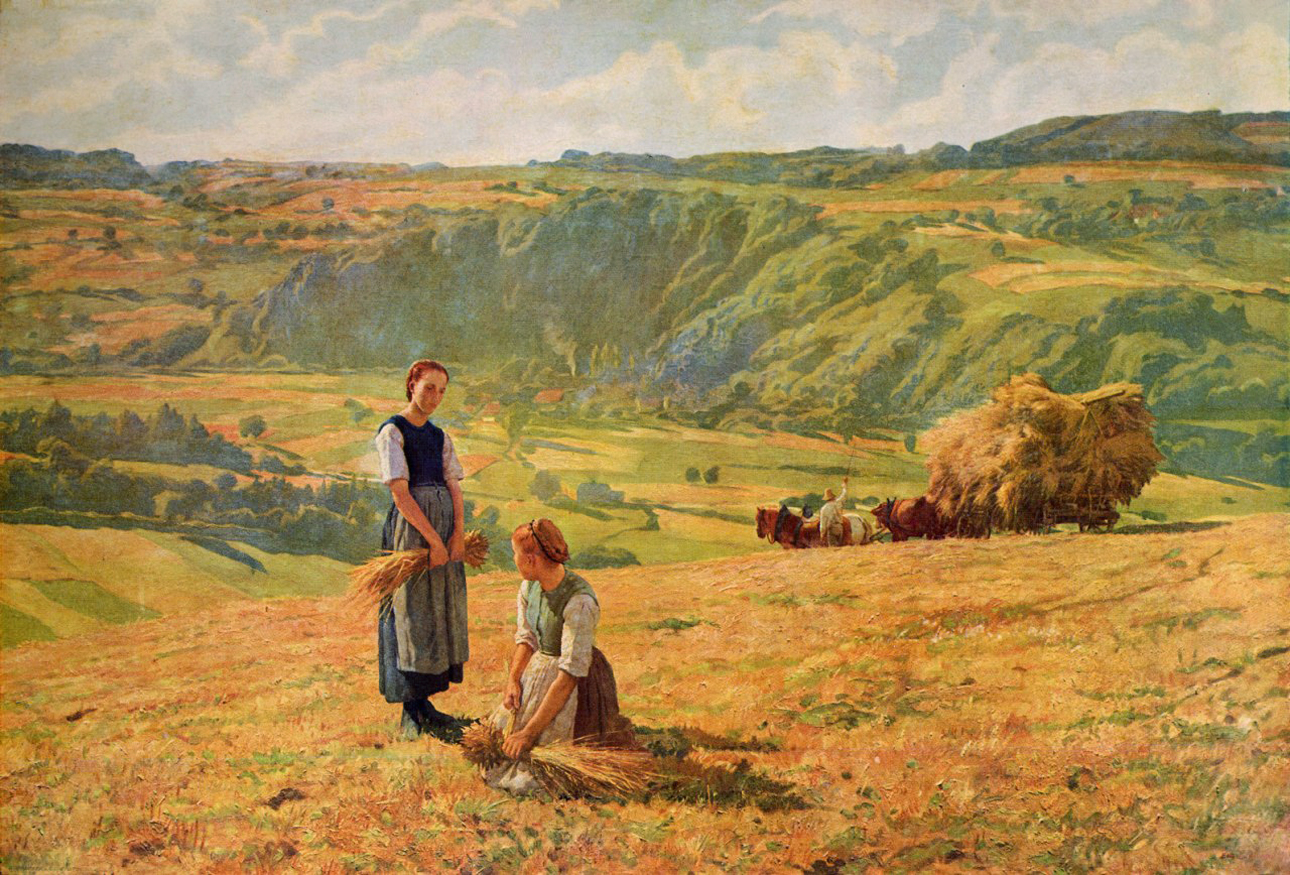

 George Clausen: Gleaners Coming Home (1904)


Le glanage est un droit d'usage sur la production agricole, existant notamment en France, sous différentes formes depuis le Moyen Âge. Il subsiste encore au 21e siècle.

Après la moisson, le ramassage de la paille et des grains tombés au sol est autorisé.


Georges Laugée (1852-1937): Les glaneurs


Georges Laugée: Les glaneuses


Giovanni Fattori (1825-1908): The Gleaners (1865)


James T. Harwood (1860-1940): The Gleaners


James Tissot (1836-1902)


[Je ne sais pas] Les glaneuses


On distingue le glanage, qui concerne ce qui reste sur le sol, du grappillage, qui concerne ce qui reste sur les arbres ou les ceps après la cueillette.


On glane donc des pommes de terre, des céréales; on grappille les raisins, les pommes, les fruits en général. 


John Constable: The Gleaners, Brighton (1824)


John Ottis Adams (1851-1927): The Gleaners at Rest aka Nooning


Jules Breton (1927-1906): Jeune glaneuse portant une gerbe


Jules Breton: Le rappel des glaneuses (1859)


Julien Dupré (1851–1910): Le repos de la glaneuse


Julien Dupré: Les glaneuses (1880)


On distingue le glanage légal du glanage illicite, le maraudage, qui est le délit de dérober des fruits, récoltes, légumes quand ils ne sont pas encore détachés du sol.


Kate Greenaway: Gleaners Going Home


Léon-Augustin Lhermitte (1844-1925): Les glaneuses (1887)

Léon-Augustin Lhermitte: Glaneuses en avant de vieilles meules (1890)


Léon-Augustin Lhermitte: Les glaneuses (1898)


Léon-Augustin Lhermitte: Les glaneuses (1901)


Thomas James Lloyd: The Gleaners (1896)


Au cours du 18e siècle, avec la réaction seigneuriale, les conditions d’exercice se durcissent: 


Le glanage est autorisé seulement après que les gerbes du seigneur, et/ou celles de la dîme, ont été enlevées; le glanage est interdit tant que des gerbes se trouvent encore à terre; le glanage des chaumes (utiles comme fourrage, litière, couverture des toits) est interdit avant septembre.   


À certains endroits, le seigneur veut même interdire le glanage, ce qui provoque émeutes et résistances diverses. Le glanage est autorisé uniquement en journée par les vieillards, les infirmes, les femmes et les enfants de moins de 12 ans. À la condition que le champ soit non clot,dans leur commune et après la récolte du fermier.


William Bouguereau: Glaneuse (1894)